Multiplication Chart Printable
1. What Is a Printable Multiplication Chart?
A printable multiplication chart is a reusable, grid-based tool that displays the products of two numbers (typically ranging from 1–10 or 1–12). Designed for easy printing, these charts serve as a quick reference for students learning basic multiplication facts and a handy resource for teachers creating lesson plans or homework assignments.
Unlike digital charts, printable multiplication charts can be laminated for durability, colored to highlight patterns, or filled in manually (for blank templates). They are ideal for classroom walls, homework folders, or at-home practice—perfect for elementary students building math fluency.
Key Features of Our Printable Multiplication Charts
- High-resolution PDF format: Crisp, easy-to-read numbers for printing on standard letter/A4 paper.
- Multiple sizes: 1-10 (beginners), 1-12 (advanced elementary), and blank templates (active practice).
- Customizable designs: Color-coded, black-and-white, and themed options (space, animals, superheroes) for all learning styles.
- Free to download: No sign-up or fees—print as many copies as you need.
2. Types of Printable Multiplication Charts (Free Downloads)
We offer a variety of printable multiplication charts to fit every learning goal. Choose the right one for your needs:
2.1 Filled 1-10 Multiplication Chart Printable
- Best for: Kindergarten to 2nd grade students new to multiplication.
- What’s included: A complete grid with products for numbers 1 through 10. Rows and columns are labeled clearly, so kids can find answers like 5×7=35 in seconds.
- Use case: Hang it on the classroom wall or send a copy home for parents to use during homework time.
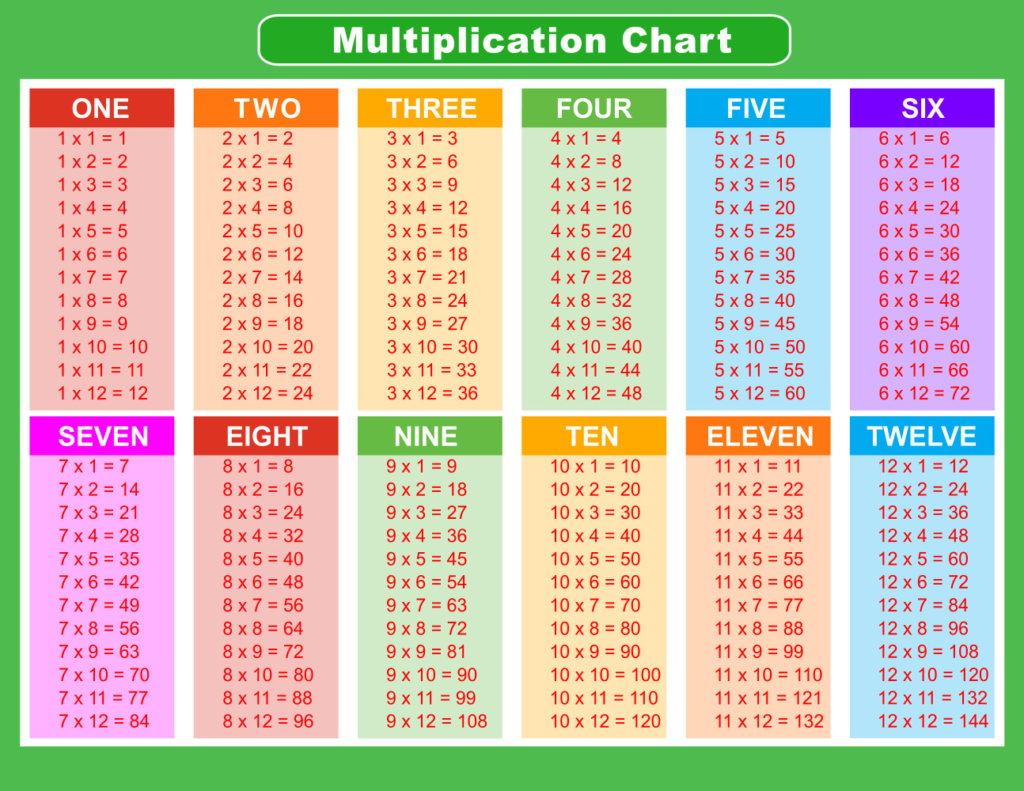
2.2 Filled 1-12 Multiplication Chart Printable
- Best for: 3rd to 5th grade students mastering advanced multiplication facts.
- What’s included: Extends to 12, aligning with standard elementary math curricula (many schools teach up to 12×12).
- Use case: Use it to teach multi-digit multiplication prep or as a reference for division problems.
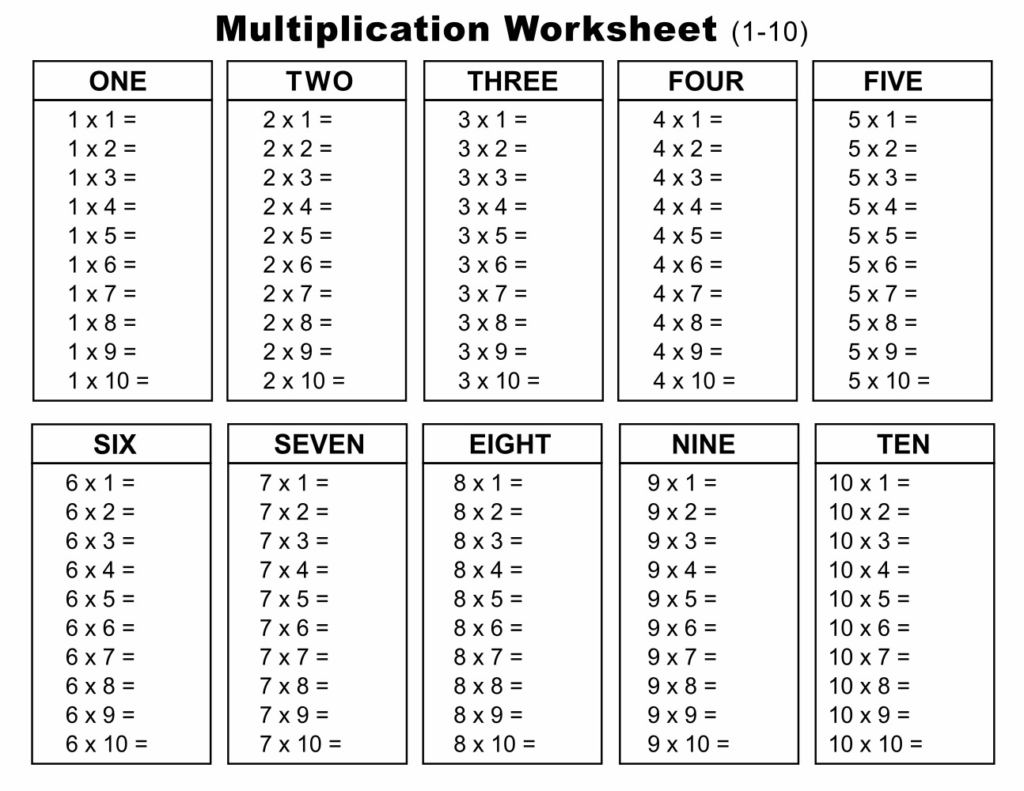
2.3 Blank Multiplication Chart Printable
- Best for: Active memorization and recall practice.
- What’s included: An empty grid with labeled rows and columns—students fill in the products from memory.
- Use case: Assign it as a timed quiz or homework to reinforce fact retention. Laminated blank charts can be reused with dry-erase markers.
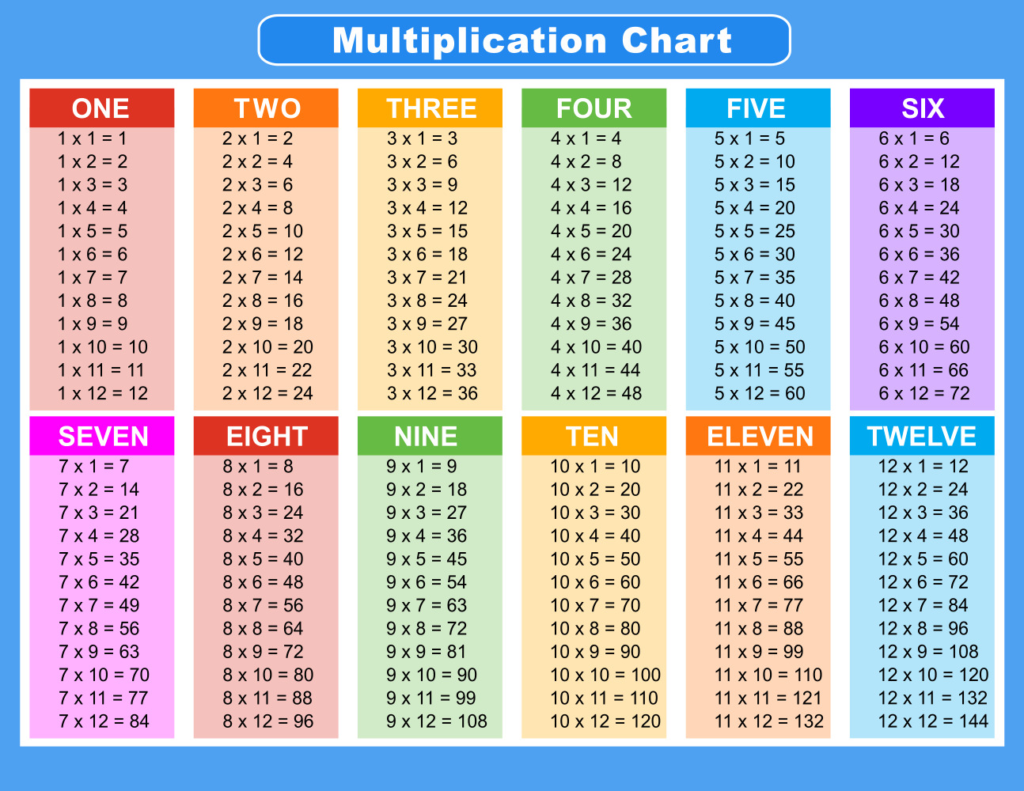
2.4 Color-Coded Multiplication Chart Printable
- Best for: Visual learners and pattern recognition.
- What’s included: Products are highlighted with colors to emphasize key patterns (e.g., multiples of 5 in blue, squares like 6×6=36 in yellow).
- Use case: Teach students to spot patterns (e.g., even products when multiplying by 2, 4, 6) instead of rote memorization.
2.5 Themed Multiplication Chart Printable
- Best for: Young kids who need extra motivation.
- What’s included: Fun designs like dinosaurs, space, unicorns, or sports themes to make math practice engaging.
- Use case: Reward kids with a themed chart after they master a set of facts—let them color the borders for extra fun.
3. How to Print & Use Your Multiplication Chart
Printing and using our multiplication charts is quick and straightforward—follow these steps for the best results:
Step 1: Download the Chart
- Choose your preferred chart (filled 1-10, blank 1-12, etc.) and click the “Download PDF” button.
- Save the file to your computer or device.
Step 2: Print the Chart
- Use standard letter-sized (8.5×11 in) or A4 paper for optimal readability.
- For durability, print on cardstock or laminate the chart after printing—this lets students use dry-erase markers on blank templates.
- For classroom displays, print on larger paper (11×17 in) to make numbers visible from across the room.
Step 3: Effective Usage Tips
- For Students: Use the filled chart to check homework answers. Practice with the blank chart daily for 5–10 minutes to build fluency.
- For Teachers: Use the color-coded chart to teach multiplication patterns. Pair blank charts with timed drills to track student progress.
- For Parents: Hang a filled chart on the fridge for quick homework help. Use the blank chart to turn practice into a game (e.g., “race to fill the 7s row”).
4. Benefits of Using Printable Multiplication Charts
Printable multiplication charts are more than just reference tools—they support long-term math success:
- Builds Fact Fluency: Quick access to facts helps students solve multi-digit multiplication and division problems faster.
- Reduces Math Anxiety: Having a reference gives students confidence to tackle hard problems without fear of getting stuck.
- Teaches Pattern Recognition: Color-coded charts help kids see relationships between numbers (e.g., 3×4=12 and 4×3=12).
- Supports Multiple Learning Styles: Visual learners benefit from color-coding; kinesthetic learners from filling in blank charts.
- Cost-Effective & Reusable: Free to download and print—laminated charts can be used for years.
5. Practice Activities with Printable Multiplication Charts
Make multiplication practice fun with these engaging activities using your printable chart:
- Pattern Hunt: Ask students to circle all multiples of 3 on the color-coded chart and describe the pattern they see.
- Timed Blank Chart Challenge: Have students fill a blank 1-10 chart in under 2 minutes—reward the fastest accurate finishers.
- Fact Matching: Write multiplication facts on flashcards (e.g., 6×8) and have students find the answer on the chart.
- Peer Teaching: Pair students—one uses the blank chart to quiz the other on facts, then switch roles.
6. Frequently Asked Questions (FAQ) About Printable Multiplication Charts
Q1: Are your multiplication charts printable for free?
A1: Yes! All our multiplication charts are 100% free to download and print. There are no sign-ups, fees, or hidden costs—print as many copies as you need.
Q2: What sizes do the printable multiplication charts come in?
A2: We offer charts in standard letter size (8.5×11 in) and A4 size, which work with most home and school printers. For classroom displays, you can resize the PDF to 11×17 in.
Q3: What is the difference between a 1-10 and 1-12 multiplication chart printable?
A3: A 1-10 chart covers facts from 1×1 to 10×10, ideal for beginners. A 1-12 chart extends to 12×12, which aligns with 3rd–5th grade math curricula in most countries.
Q4: Can I customize the printable multiplication chart?
A4: Yes! Our blank templates let you add your own colors, labels, or themes. You can also edit the PDF to highlight specific rows/columns before printing.
Q5: Is a blank multiplication chart printable better for learning?
A5: It depends on the goal. Filled charts are great for reference, while blank charts are best for active memorization—filling them in from memory reinforces fact retention better than just reading a chart.
Q6: How do I laminate a printable multiplication chart?
A6: Print the chart on cardstock for sturdiness, then use a home laminator or take it to a local office supply store (e.g., Staples, Office Depot) for professional lamination. Laminated charts can be reused with dry-erase markers.
Q7: Can I use these printable charts for homeschooling?
A7: Absolutely! These charts are perfect for homeschool curricula. Use the 1-10 chart for early elementary, the 1-12 chart for upper elementary, and blank charts for assessments.
Q8: Are there themed printable multiplication charts for kids?
A8: Yes! We have themed charts with dinosaurs, space, unicorns, sports, and more. Themed charts make practice fun for young kids who might find plain charts boring.
Q9: What is the best way to teach multiplication with a printable chart?
A9: Start by showing students how to find a product (e.g., 7×4 is the intersection of row 7 and column 4). Then use the color-coded chart to teach patterns, like how multiplying by 10 adds a zero to the number.
Q10: Can I print a multiplication chart for the classroom wall?
A10: Yes! Resize the PDF to 11×17 in or larger for a classroom display. A large, colorful chart on the wall is a constant reference for students during math class.
Q11: Are the printable multiplication charts available in PDF format?
A11: Yes, all our charts are available as high-resolution PDFs. PDFs ensure the chart looks crisp when printed, no matter the size.
Q12: Can I use these charts for remote learning?
A12: Yes! You can email the PDF to students for them to print at home, or share a digital version for them to use on their devices during virtual lessons.
Q13: How often should my child practice with a printable multiplication chart?
A13: Short, consistent practice is best—5–10 minutes per day. Have them fill in one row of the blank chart daily (e.g., the 3s on Monday, 4s on Tuesday) to avoid overwhelm.
Q14: Do you have a printable multiplication chart for special needs learners?
A14: Yes! We offer large-print charts with bold numbers for learners with visual impairments, and color-coded charts that help students with dyscalculia recognize patterns instead of memorizing random facts.
Q15: Can I share the printable multiplication charts with other teachers or parents?
A15: Yes! Feel free to share the download link with colleagues, friends, or parent groups. These charts are designed to be shared to support as many students as possible.
Q16: What’s the best paper type for printing multiplication charts?
A16: Cardstock is the best choice for durability, especially if you plan to laminate the chart. For everyday use, standard printer paper works fine.
Q17: Can I use the printable charts for quizzes or assessments?
A17: Yes! The blank multiplication chart is perfect for timed quizzes. You can also use it to test students’ ability to recall facts without a reference.
Q18: Are there printable multiplication charts for division practice?
A18: While our charts focus on multiplication, they can be used for division too! For example, to solve 42÷6, find 42 on the chart and see which row/column it’s in (6 and 7).
Q19: How do I teach my child to use a multiplication chart printable?
A19: Start with simple facts (e.g., 2×3). Show them to find row 2 and column 3—their intersection is the answer (6). Practice with easy facts first, then move to harder ones.
Q20: Can I get a printable multiplication chart that highlights square numbers?
A20: Yes! Our color-coded chart highlights square numbers (e.g., 5×5=25, 8×8=64) in a different color to help students identify them easily.
Q21: Are the printable multiplication charts aligned with common core standards?
A21: Yes! Our 1-10 and 1-12 charts align with Common Core math standards for 3rd grade, which require students to master multiplication facts up to 12×12.
Q22: Can I print a multiplication chart for my child’s homework folder?
A22: Absolutely! A small, laminated 1-10 chart fits perfectly in a homework folder. It’s a handy reference for kids to use when they get stuck on multiplication problems at home.
Q23: Do you have a black-and-white multiplication chart printable?
A23: Yes! We offer black-and-white versions of all our charts, which use less ink when printing. Kids can color them in to make them their own.
Q24: How do I track my child’s progress with a blank multiplication chart?
A24: Have your child fill a blank chart weekly and note how long it takes them and how many mistakes they make. Over time, you’ll see them get faster and more accurate.
Q25: Can I use these printable charts for group activities in the classroom?
A25: Yes! Divide students into teams and have them race to fill a blank chart, or use the color-coded chart for a group pattern hunt activity.
Q26: Are there printable multiplication charts for numbers beyond 12?
A26: Our standard charts go up to 12, but we offer custom blank templates that you can extend to 15 or 20 if needed—perfect for advanced students.
Q27: How do I prevent the printable multiplication chart from fading?
A27: Laminating the chart will protect it from fading, smudges, and tears. If you don’t have a laminator, use a clear plastic sheet cover instead.
Q28: Can I use the printable charts for summer math practice?
A28: Yes! Print a blank chart and have your child fill it in once a week during summer break to prevent “summer slide” and keep their math skills sharp.
Q29: Do you have a multiplication chart printable that’s easy for left-handed kids to use?
A29: Yes! Our charts are designed to be used by both left and right-handed students—rows and columns are labeled on both sides for easy access.
Q30: Can I use these charts to teach multiplication to ESL students?
A30: Yes! The charts use numbers instead of words, making them ideal for ESL students. You can also add simple labels (e.g., “row,” “column,” “product”) in multiple languages if needed.
7. Conclusion
A printable multiplication chart is a timeless tool that helps students build math fluency, reduce anxiety, and recognize number patterns. Our free, customizable charts are designed for every learning style and grade level—from beginner 1-10 charts to advanced 1-12 templates.
Download your chart today, print it out, and start making multiplication practice fun and effective for your students or kids!